Registers that update themselves when a resolution passes
Members, options, class rights and convertibles — the register every Pty Ltd must keep and produce on request, written straight through from every passed resolution. Nothing here is a second, hand-kept spreadsheet.
Every movement traces to a passed resolution · minute book #4
Illustrative — Solstice Labs demo data
The members register, always current
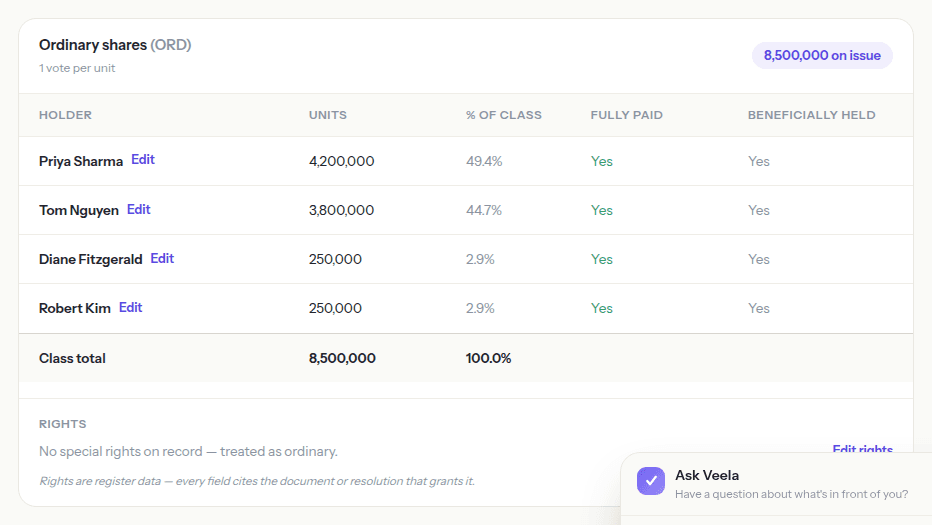
Every Pty Ltd must keep a members register and produce it on request — who holds what, how many units, whether it's fully paid, and whether the holding is beneficial or held on behalf of someone else. Veela renders that register live from your company's own resolutions, so it reads correctly the moment a share issue or transfer passes, not after someone remembers to update a spreadsheet. There's no parallel copy to keep in sync and no export that quietly drifts from what actually happened — the register you're looking at is the same one every other part of the platform, from the cap table to the ASIC hub, reads from.
- Holders, units, percentage of class, fully paid status and beneficial holding recorded against every line
- Carries up to 25 members on any plan, no integration required
- Updates the moment a share issue, transfer or cancellation resolution passes — nothing re-typed
Class rights, cited back to the document that created them
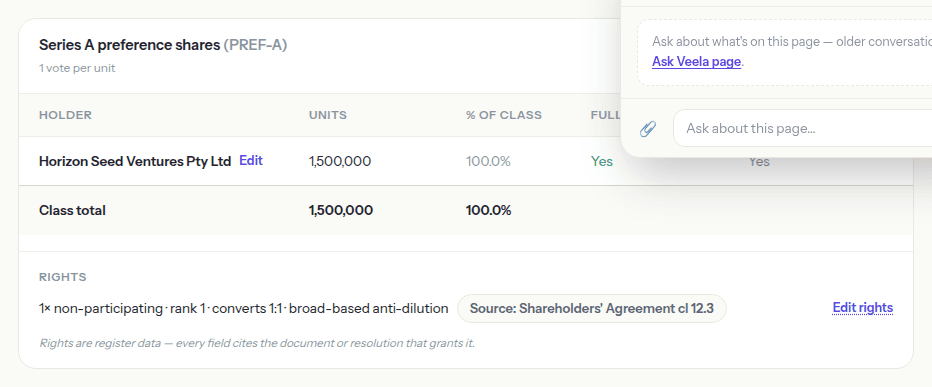
Preference multiples, ranking, conversion ratios and anti-dilution protection are rights your shareholders' agreement actually grants — Veela records them as a first-class register, not a note in someone's inbox. Upload the agreement and Veela's AI reads it and proposes the class rights for you to confirm; every recorded right carries a citation back to the clause it came from, so nobody has to take the register's word for it. Get a new class wrong on paper and the mistake follows you into every later decision that touches it — a raise, a conversion, an exit — so the citation matters as much as the right itself.
- AI extract-and-confirm from an uploaded shareholders' agreement — you approve what it proposes
- Preference multiple, rank, conversion ratio and anti-dilution — each with a source citation, e.g. "PREF-A — Shareholders' Agreement cl 12.3"
- Feeds the exit waterfall on the Equity page directly — nothing gets re-typed for modelling
Options that vest themselves
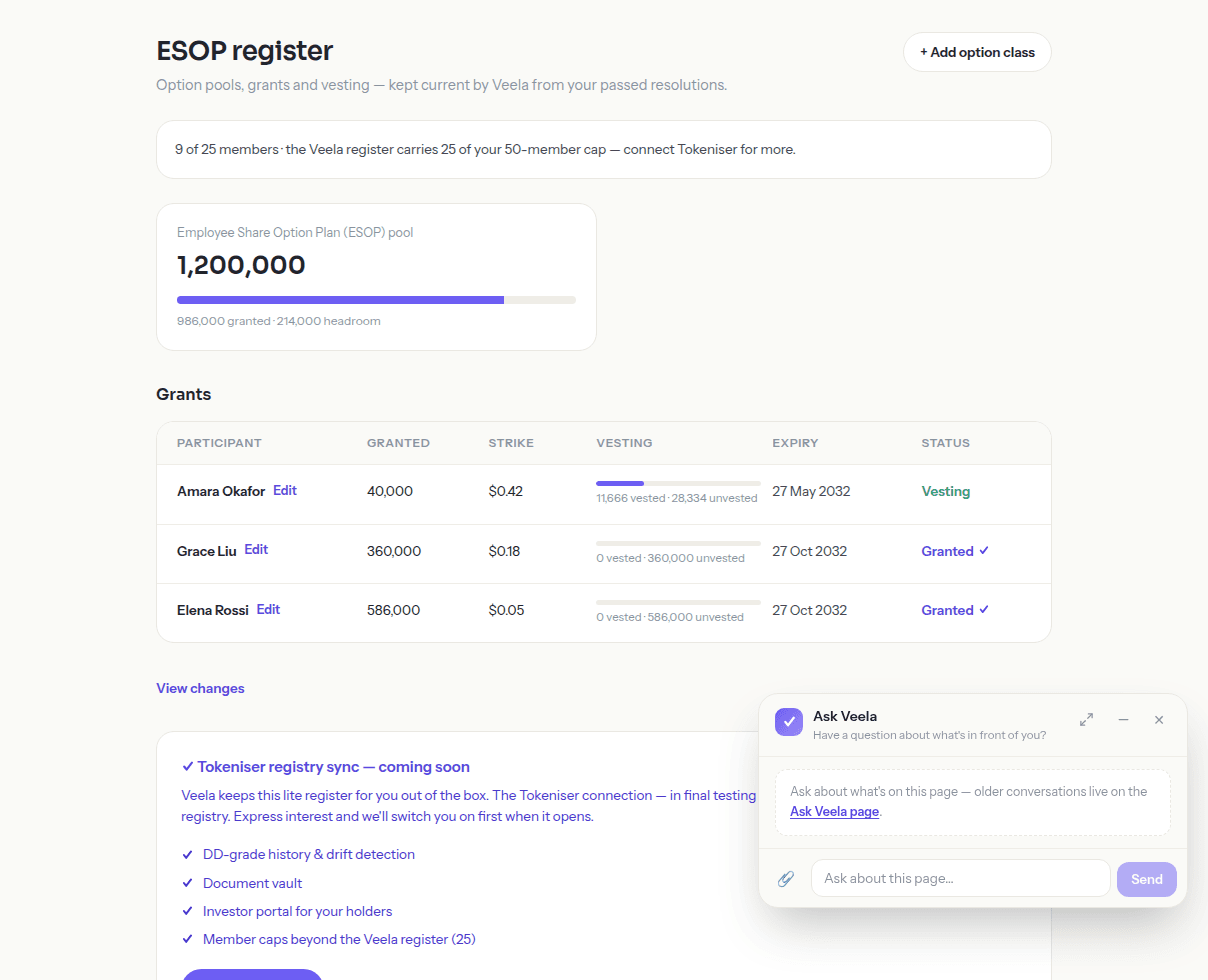
An ESOP grant is drafted, approved and signed like any other resolution — and the moment it passes, Veela writes the grant to the option register, computes the vesting schedule and cliff, and steps pool headroom down automatically. Nobody maintains a parallel vesting spreadsheet, and nobody has to remember to update the pool balance after a grant goes out. The next offer you draft reads the same headroom figure, so it's never accidentally sized against a pool that's already spoken for.
- Vesting and cliffs computed automatically from the grant's own terms — no manual tracking
- Pool headroom steps down the moment a grant is approved, so the next offer is never overcommitted
- Every option traces back to the resolution that granted it
Every movement traces to a passed resolution
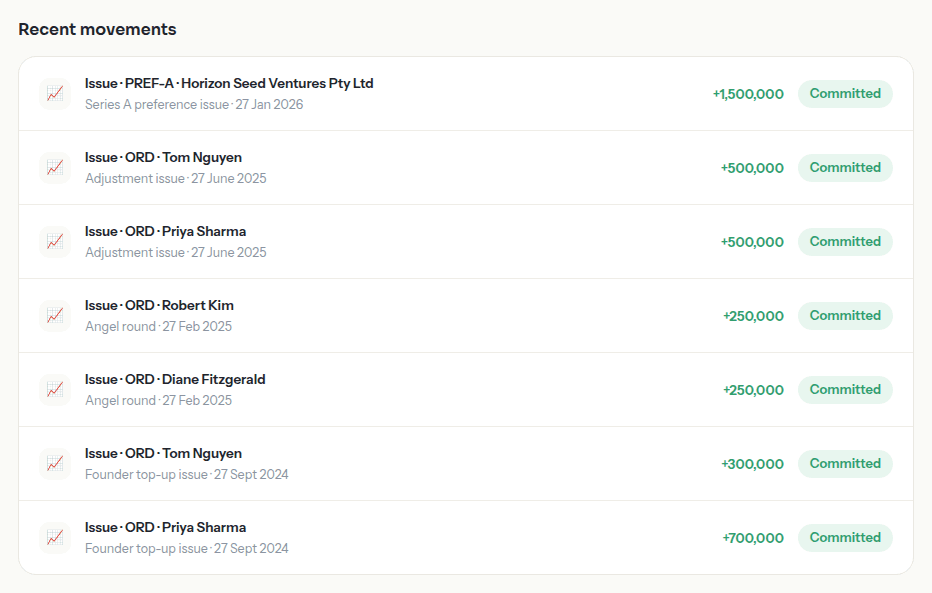
Issues, transfers, cancellations, conversions — the full movement history sits behind every current balance, and every row traces back to the resolution and minute book entry that authorised it. That's exactly what a due-diligence data room will ask for, already assembled rather than reconstructed under time pressure. The same record supports notifying ASIC of share issues and changes within its 28-day window, and ESS reporting to the ATO draws on the same option register rather than a separate spreadsheet. Tokeniser connection — coming soon, currently in final testing — lifts the Veela-kept register's cap and adds DD-grade history, a document vault and an investor portal.
- Every movement traced to the resolution and minute book entry that authorised it
- Issues, transfers, cancellations and conversions all on one history, not scattered across sheets
- Tokeniser connection (coming soon — in final testing) lifts the cap to 50 members, with DD-grade history, a document vault and an investor portal
A register for SAFEs and notes, not a footnote
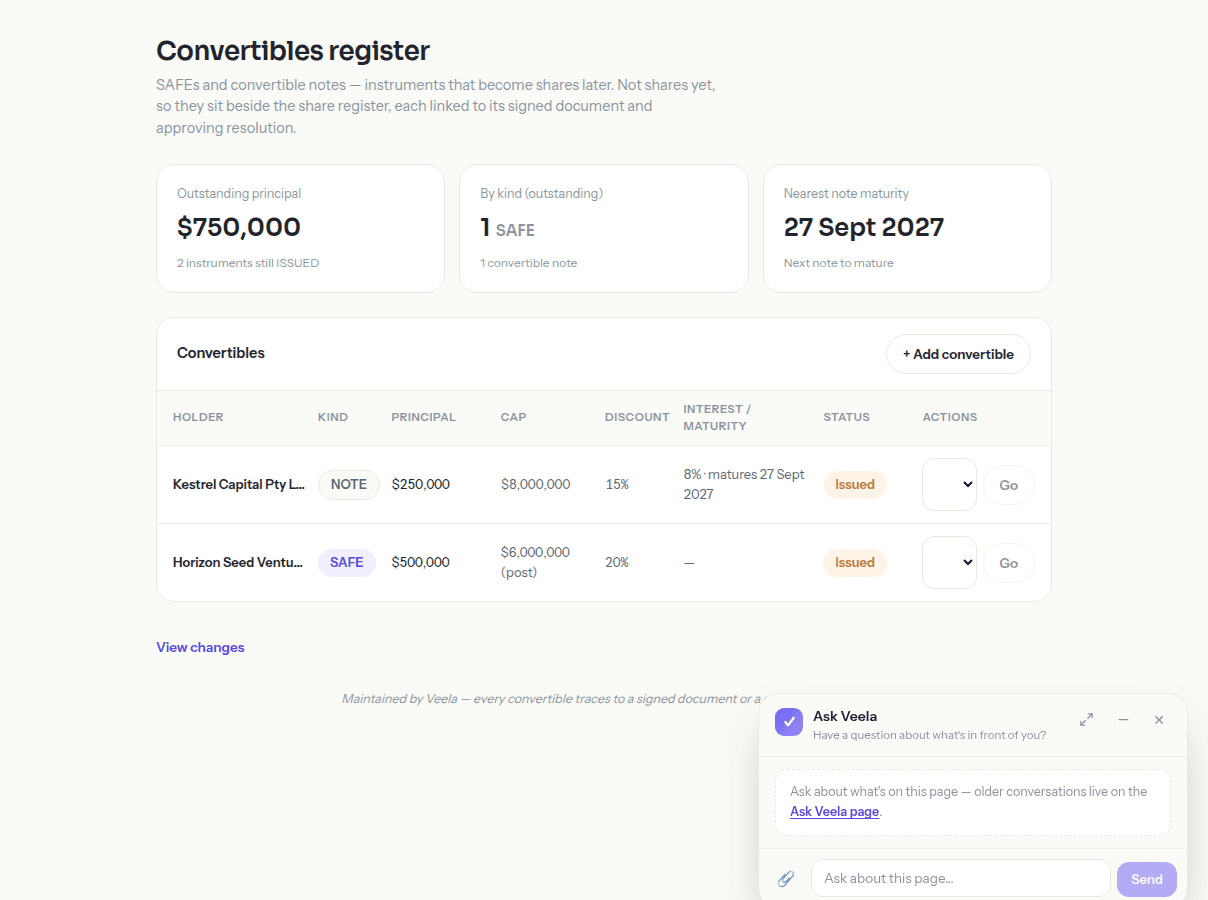
A SAFE or a convertible note isn't a share yet, and treating it as one until it converts would misstate the register — so Veela keeps a dedicated convertibles register instead, tracking each instrument through issue, accruing interest and conversion, linked back to the resolution that created it. It sits outside the members register for exactly as long as it should, and the exit waterfall and the raise calculator both read it directly rather than a re-typed summary. Conversion mechanics follow the standard terms; SAFE conversion specifically is modelled as a documented approximation, not a substitute for the cap table your lawyer signs off on.
- SAFEs and notes tracked through issue, accruing interest and conversion, each linked to the resolution that created it
- Held outside the members register until conversion — a dedicated register, not a footnote
- SAFE conversion is a documented approximation, read directly by the exit waterfall and raise calculator
Why this matters if you’re a Pty Ltd
A Pty Ltd's register isn't paperwork on the side — it's the record ASIC, investors and your own board rely on being right. Veela treats it as the single source of truth the rest of the platform reads from, rather than something reconciled against a spreadsheet after the fact.
The register you must produce on request
Every Pty Ltd must keep a members register and be ready to produce it on request. Veela keeps that register current from the resolutions that actually changed it, not from a spreadsheet someone updates when they remember.
Notifying ASIC starts from the same record
An officer change or share issue starts ASIC's 28-day window for notifying the change the moment it passes. The lodgement pack is prepared from the same register entry, so nothing gets re-keyed under a deadline.
Ready before due diligence asks
A data room's first request is usually the register, its movement history and its class rights. When all three are already current and cited, that request stops being a fire drill.
Not sure? Just ask Veela
Ask Veela sits on every registers page, grounded in your company's own register rather than a general explanation of company law. Ask it who holds what, what a class actually carries, or whether a movement has been notified to ASIC yet — it answers from your live register and documents, with the citation attached, and can take you straight to the relevant draft or task.
- “How many options do we have left in the ESOP pool?”
- “What rights does PREF-A actually have?”
- “Has this share issue been notified to ASIC yet?”
- “When does Amara's vesting cliff end?”
- “Show me every movement against the register this year.”
Keep exploring
A cap table you can interrogate — time travel, exit waterfall and raise modelling that never touch the register.
Read more →Personal signing links with no accounts to create, and an immutable minute book that fills itself.
Read more →Form 484 lodgement packs prepared the moment a resolution passes — send to your agent or self-file.
Read more →See it running on your own facts
Start free for 7 days, or try the no-signup sandbox first — same platform, illustrative data.