The record holds up, because the decision wrote it
Registers, class rights and the minute book aren't kept alongside your resolutions — they are written by them. So when a bank, an investor or ASIC asks how a holding came to exist, the answer is one record with the resolution, the check and the signatures already attached.
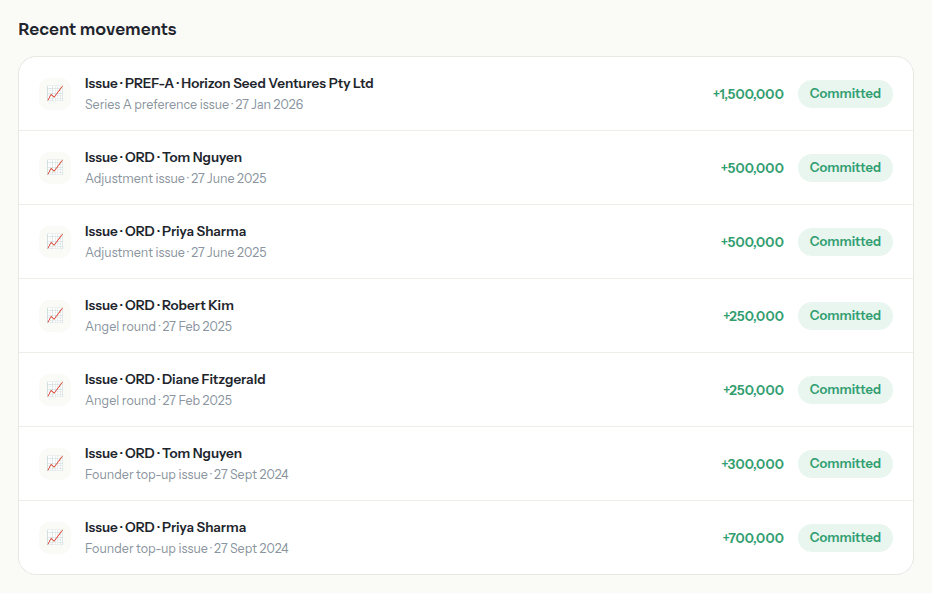
Every movement traces to a passed resolution · minute book #4
Illustrative — Solstice Labs demo data
The register every Pty Ltd must keep, always current
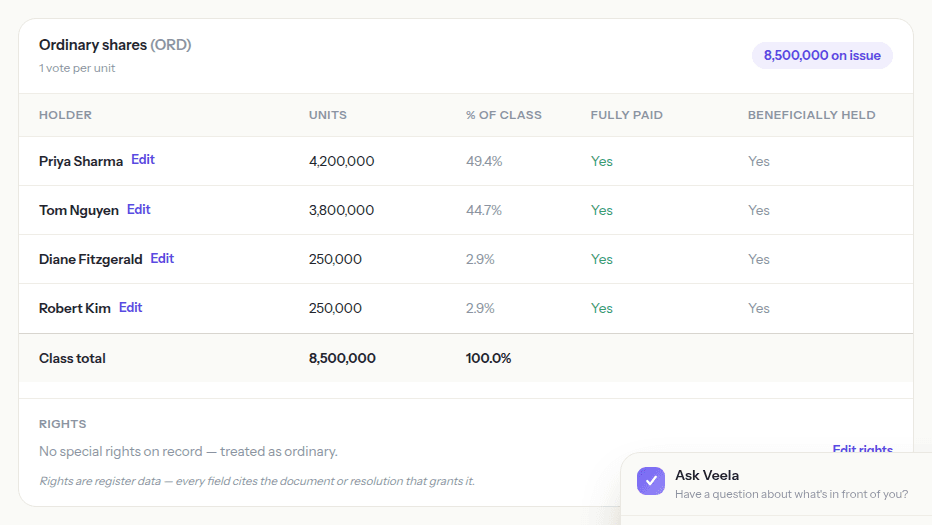
Your company has to keep a members register and produce it on request — who holds what, how many units, whether it's fully paid, and whether the holding is beneficial or held on behalf of someone else. Veela renders that register live from your own passed resolutions, so it reads correctly the moment a share issue or transfer passes rather than after someone remembers to update a spreadsheet. There is no second copy: the register you're looking at is the one the cap table, the option register and the ASIC hub all read from.
- Holders, units, percentage of class, fully paid status and beneficial holding recorded against every line
- Updates the moment a share issue, transfer or cancellation passes — nothing re-typed
- The Veela-kept register carries up to 25 members with nothing to integrate
Class rights, cited back to the document that created them
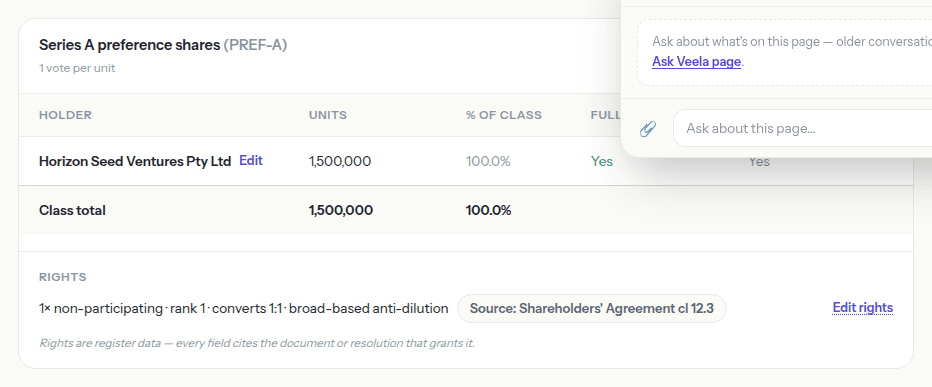
Preference multiples, ranking, conversion ratios and anti-dilution protection are rights your shareholders' agreement actually grants — Veela records them as a register in their own right, not a note in someone's inbox. Upload the agreement and Veela reads it and proposes the class rights for you to confirm; every recorded right carries a citation back to the clause it came from, so nobody has to take the register's word for it.
- Extracted from an uploaded shareholders' agreement and proposed for you to approve — never recorded on Veela's say-so
- Preference multiple, rank, conversion ratio and anti-dilution, each with its source clause — e.g. "PREF-A — Shareholders' Agreement cl 12.3"
- The same recorded rights the exit waterfall reads, so nothing is re-typed for modelling
Options that vest themselves
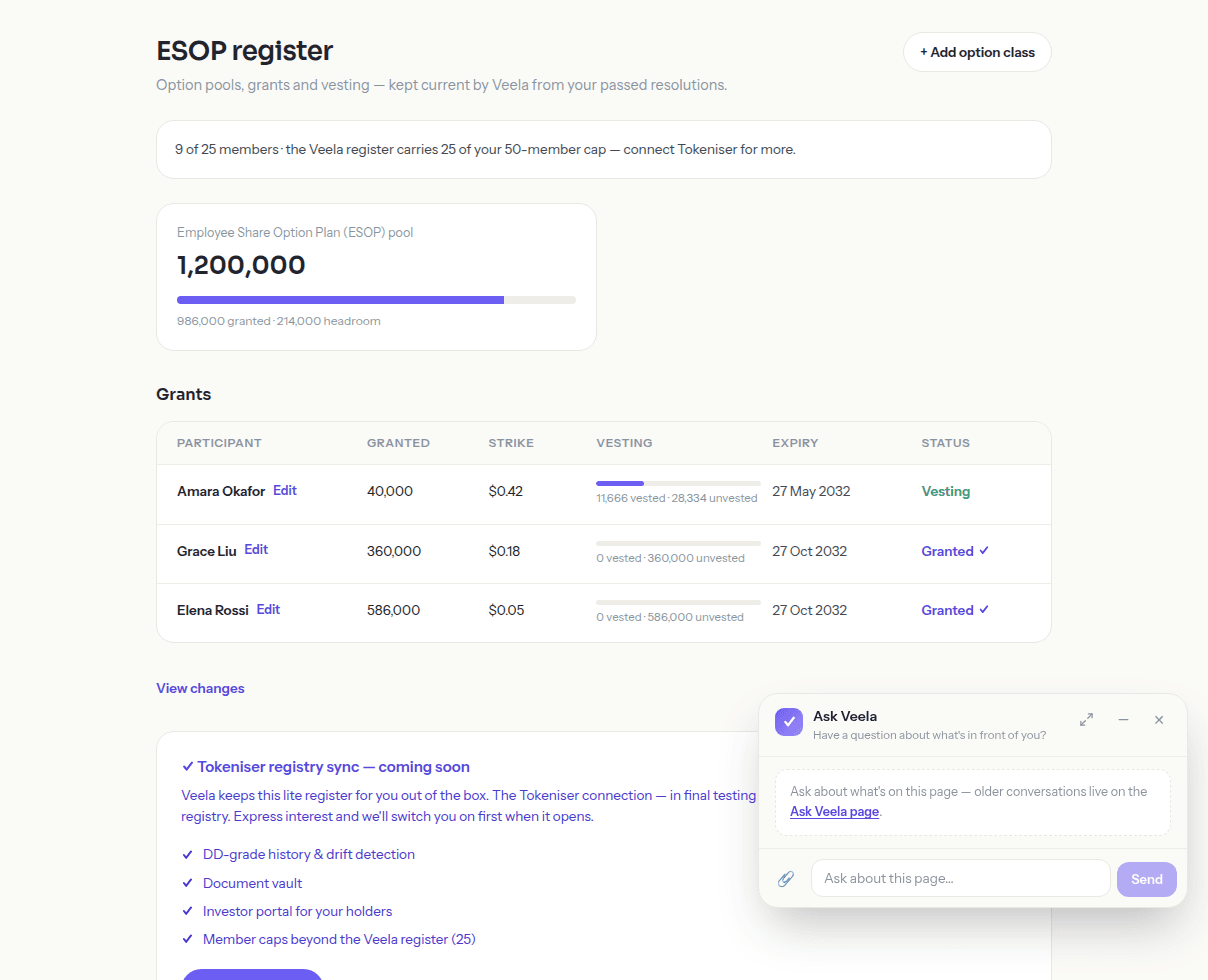
An ESOP grant is drafted, approved and signed like any other resolution — and the moment it passes, Veela writes the grant to the option register, computes the vesting schedule and cliff from the grant's own terms, and steps the pool balance down. Nobody keeps a parallel vesting spreadsheet, and nobody has to remember to reduce the pool after an offer goes out. Time-based tranches vest as the schedule reaches its dates; a milestone tranche waits for a board confirmation, so nothing vests on an assumption no one signed off.
- Vesting and cliffs computed from the terms on each grant — nothing tracked by hand
- Milestone tranches wait for a recorded board confirmation before they count as vested
- The unallocated pool falls the moment a grant is approved, so the next offer is never overcommitted
A register for SAFEs and notes, not a footnote
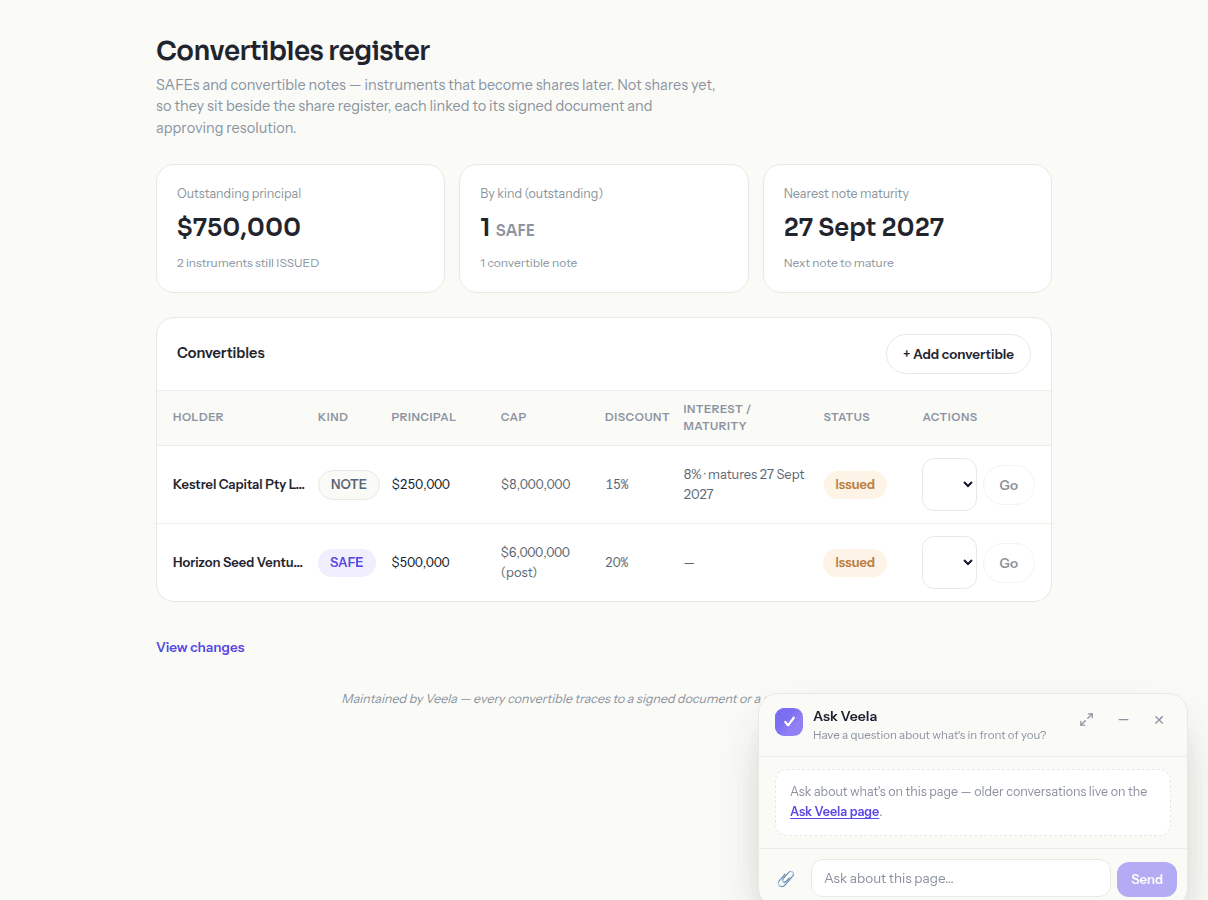
A SAFE or a convertible note isn't a share yet, and carrying it as one until it converts would misstate the register — so Veela keeps a dedicated convertibles register instead, tracking each one through issue, accruing interest and conversion, linked back to the resolution that created it. The exit waterfall and the raise calculator both read it directly rather than a re-typed summary. SAFE conversion specifically is modelled as a documented approximation, not a substitute for the cap table your lawyer signs off on.
- SAFEs and notes tracked through issue, accruing interest and conversion, each linked to its resolution
- Held outside the members register until conversion — a register of its own, not a footnote
- SAFE conversion is a documented approximation, and says so wherever it appears
Every movement traces to a resolution that passed
Issues, transfers, cancellations, conversions — the full movement history sits behind every current balance, and every row traces back to the resolution and the minute book entry that authorised it. That is exactly what a due-diligence data room asks for first, already assembled rather than reconstructed under time pressure. The same record is what a share issue notification to ASIC is built from, and ESS reporting to the ATO draws on the same option register rather than a separate sheet.
- Every movement traced to the resolution and minute book entry behind it
- Issues, transfers, cancellations and conversions on one history, not scattered across sheets
- Tokeniser connection (coming soon — in final testing) lifts the cap to 50 members, with DD-grade history, a document vault and an investor portal
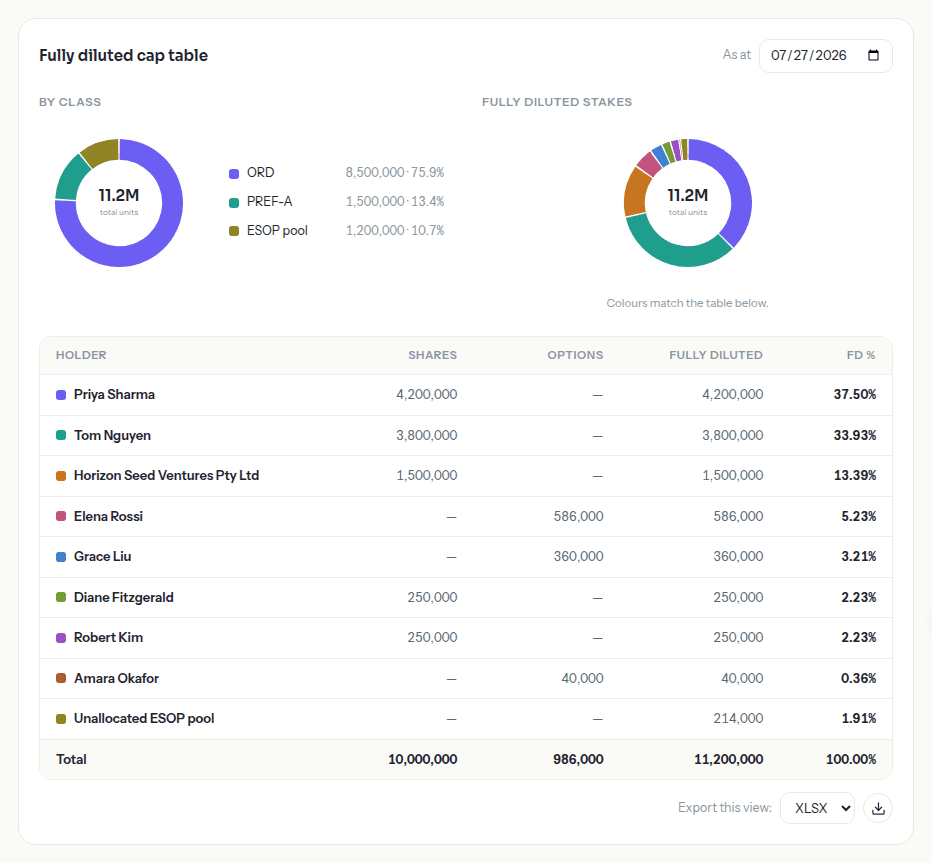
Step back to any date, and export what the register showed then
Switch the "as at" date and the whole view rewinds to what the register actually held on that day, export included — so a board pack, an investor update or an auditor's request can quote an exact historical position rather than an approximation someone reconstructed. The donuts and the table are colour-linked, because colour follows the entity rather than its rank on the day, and fully diluted counts the ESOP pool and what's left unallocated in it, not only the shares currently on issue.
- The "as at" date rewinds the view to what the register held then, and the export carries that date
- Linked donuts and table — hover one, the other highlights the same holder or class
- Fully diluted includes the ESOP pool and its unallocated balance, not just shares on issue
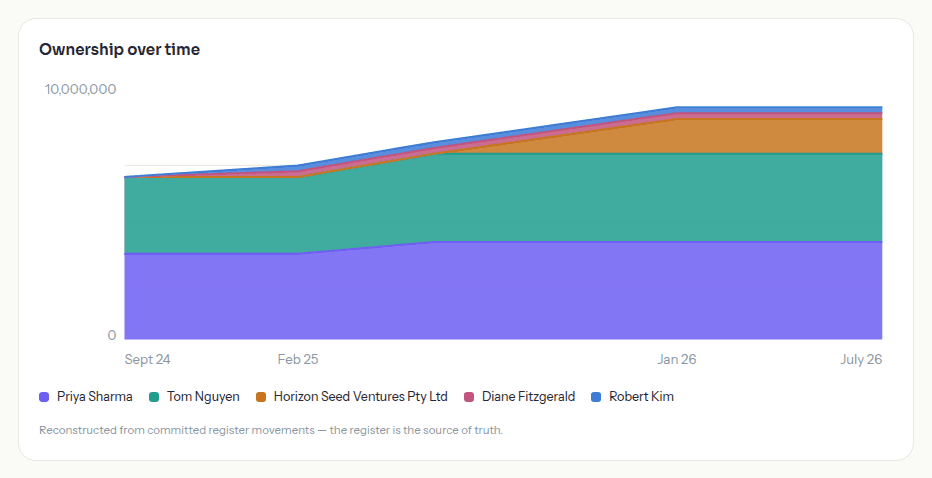
Ownership over time, reconstructed — not remembered
The ownership history chart isn't a separate timeline someone maintains by hand — it's rebuilt from the same committed register movements the cap table already reads, bucketed daily, weekly or monthly once there's enough span for that to mean anything. Ask how ownership has shifted since the seed round and the answer comes from the record, not from someone's recollection of what happened.
- Built entirely from committed register movements — nothing re-entered separately
- Buckets daily, weekly or monthly once the span makes that meaningful
- A sourced answer to how ownership has changed since any earlier date
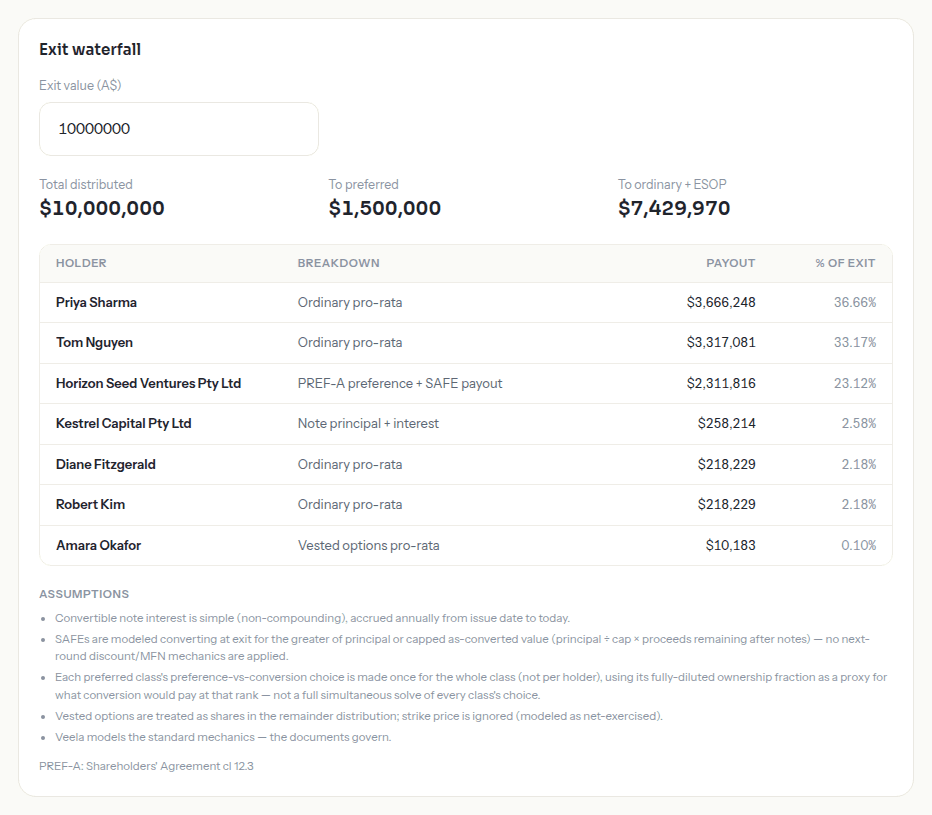
An exit waterfall that shows its working
Run an exit value through and Veela settles notes and SAFEs first, then works up the preference stack by rank — each preferred class rationally choosing between taking its preference and converting to ordinary — before splitting the remainder pro-rata across ordinary units, vested options and any converted or participating preferred. Every preference line cites the exact clause it relies on, which is the same citation a due-diligence reviewer will ask to see, so nobody has to take the number on faith.
- Every preference line cites its clause — e.g. "PREF-A — Shareholders' Agreement cl 12.3"
- Notes and SAFEs settle first, then the preference stack by rank, then the pro-rata remainder
- SAFE conversion is a documented approximation — a guide for the room, not a signed cap table
Modelling is a lens on the record, never a write to it
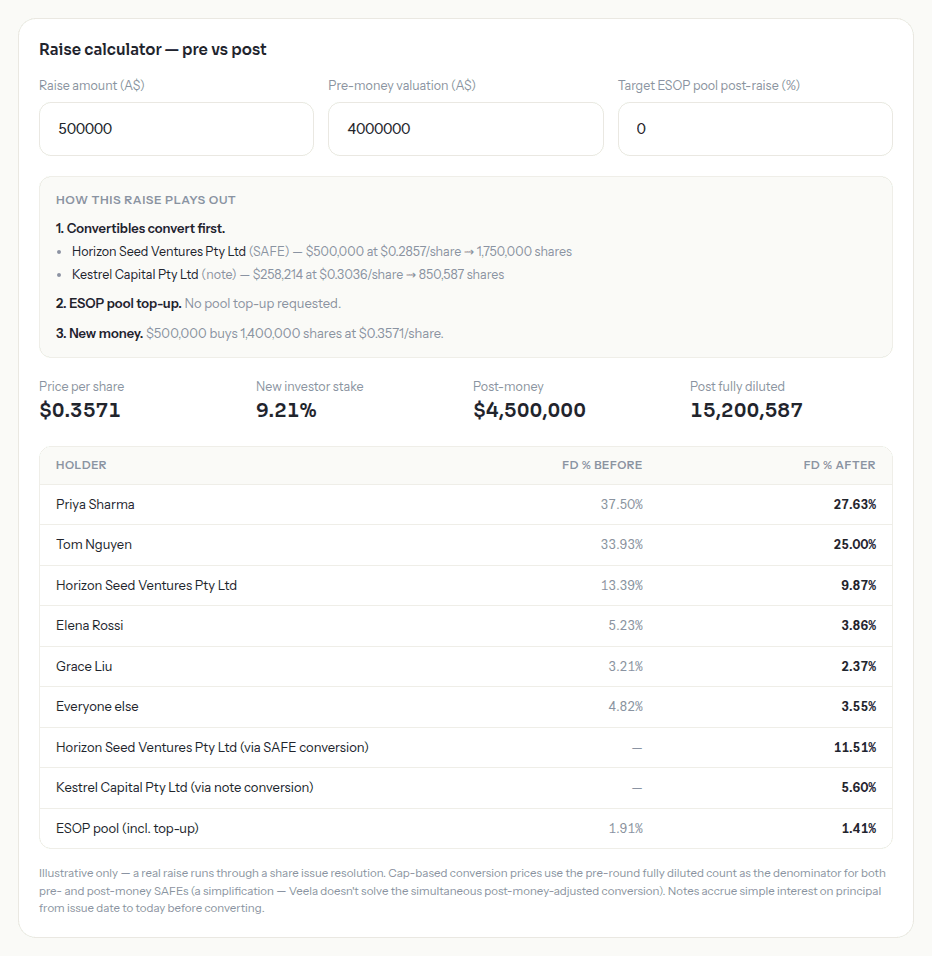
Run a raise at whatever pre-money and amount you're actually discussing and see the fully diluted percentage before and after, side by side, with SAFE and note conversion and an ESOP pool top-up modelled in the same pass. None of it is committed. You can look at the numbers from as many angles as you like, but the only thing that ever changes what's true is a resolution that passed with the right approvals attached — which is the whole reason the register can be relied on in the first place.
- Pre- and post-money, fully diluted percentage before and after, side by side
- SAFE and note conversion and an ESOP top-up modelled together
- Nothing modelled touches the register — change flows only through a passed resolution
The minute book fills itself, and can't be edited afterwards
The moment the last required signature lands, the resolution is marked passed — sealed, dated and filed into an immutable minute book with its signature evidence attached to that entry permanently. Nothing is retyped, and nothing can be edited afterwards, by anyone, including us. When a bank, an investor or ASIC asks to see the record of a decision, it's already there, ready to export as a single due-diligence bundle instead of assembled by hand the week it's asked for.
- Passed resolutions file themselves — there is no filing step to forget
- Every entry carries its own signature evidence, permanently and unedited
- Export a due-diligence bundle of the whole minute book in one go
Signature evidence attached to the entry — no signatory ever created an account.
Illustrative — Solstice Labs demo data
One library for every file the company holds
Constitution, shareholders' agreement, ESOP rules, signed resolutions, ASIC correspondence, board packs — one library rather than a scatter across email and someone's laptop. Folders, filter chips and a search box keep it navigable as it grows. Mark a document admin-only and it disappears for reviewer and view only seats: out of the library, and out of Ask Veela's answers too, because the same filter runs over the context the model is given.
- 1 GB of document storage included on every plan, then +$10/month per additional GB
- PDF, spreadsheet and Word uploads, up to 25 MB each
- Drag-and-drop upload with a Kind and Folder selector, so filing takes one step, not two
- The library and Ask Veela read through the same restriction, so an admin-only document never reaches the model for anyone who can't open it
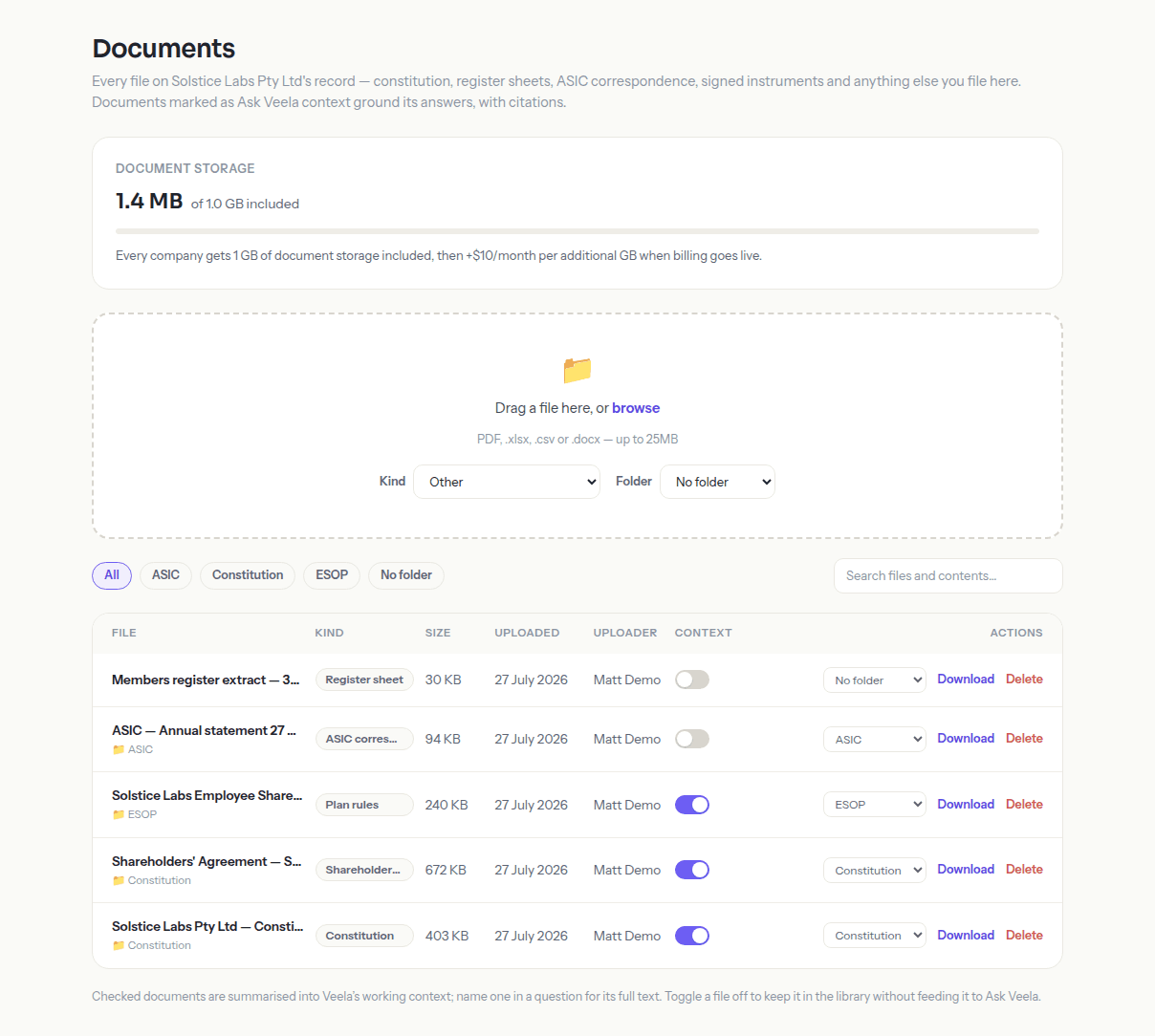
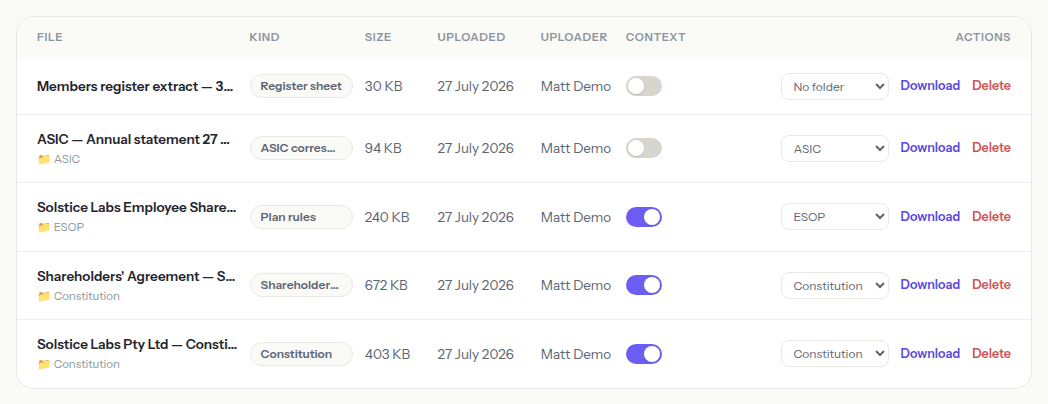
You choose, file by file, what Veela is allowed to read
Nothing is context by default. Each row in the library carries its own Ask Veela context switch, so you decide document by document what informs future answers — this month's board pack, yes; a superseded draft, no. Turn one on and Veela digests it in the background straight away. When you ask a question it works from the full text of the few documents most relevant to what you asked, plus digests of everything else you've switched on, and names any document you name directly. Every answer shows which file it drew on, so you can open the source and check it before you rely on it.
- A visible on/off switch per document, not a blanket setting for the library
- Turning context off never deletes or archives the file — it just stops being read
- Digests generate on upload or the moment you switch a file on — nothing to trigger by hand
- Citations point at the specific document and clause, not "your files"
Why this matters if you’re a Pty Ltd
A Pty Ltd's register isn't paperwork on the side — it's the record ASIC, investors and your own board rely on being right, and it has to be produced on request. Veela treats it as the one source of truth everything else reads from, rather than something reconciled against a spreadsheet after the fact.
The register you must produce on request
Every Pty Ltd must keep a members register and be ready to produce it. Veela keeps it current from the resolutions that actually changed it, not from a sheet someone updates when they remember.
The minute book every company must keep
Passed resolutions, signed documents and the evidence behind them are kept together automatically, so the record required of your company is never something you reconstruct afterwards.
Notifying ASIC starts from the same record
An officer change or share issue starts ASIC's 28-day window the moment it passes. The lodgement pack is built from the same register entry, so nothing is re-keyed under a deadline.
Every number has a receipt
Waterfall lines and class rights cite the clause they rely on rather than a formula nobody can see — the same citation a due-diligence reviewer or your lawyer will ask for before relying on it.
Ready before due diligence asks
A data room's first request is usually the register, its movement history and its class rights. When all three are already current and cited, that request stops being a fire drill.
A shelf your own officers can't reach
A document marked admin-only is invisible to reviewer and view only seats — out of the library, and out of the context Ask Veela is given when they ask. Only an owner or admin sees it either way.
Not sure? Just ask Veela
Ask Veela reads the same register and library you're looking at, so the answer is about your company rather than company law in general. Ask who holds what, what a class actually carries, or what the register showed on an earlier date — it answers from the live record with the citation attached, and nothing it says changes the register.
- “What rights does PREF-A actually have?”
- “What would our cap table look like as at 1 January?”
- “Show me every movement against the register this year.”
- “Walk me through what PREF-A gets in a $15m exit.”
- “Export a due diligence bundle of the minute book.”
Keep exploring
Drafted from your own constitution, checked before anyone sees it, approved by a named human, signed without anyone creating an account.
Read more →A sentinel that opens the work early — the annual review, director ID, ESS reporting, option expiries — and ASIC packs that build themselves.
Read more →See it running on your own facts
Start free for 7 days, or try the no-signup sandbox first — same platform, illustrative data.