Decisions get made properly, and the record is the same act
Drafted from your own constitution, plan rules and live register. Checked before a human sees it. Approved by a named person. Signed without anyone creating an account. And when it passes, the register moves in the same act — so the cap table and the minute book can't disagree.
Illustrative — Solstice Labs demo data
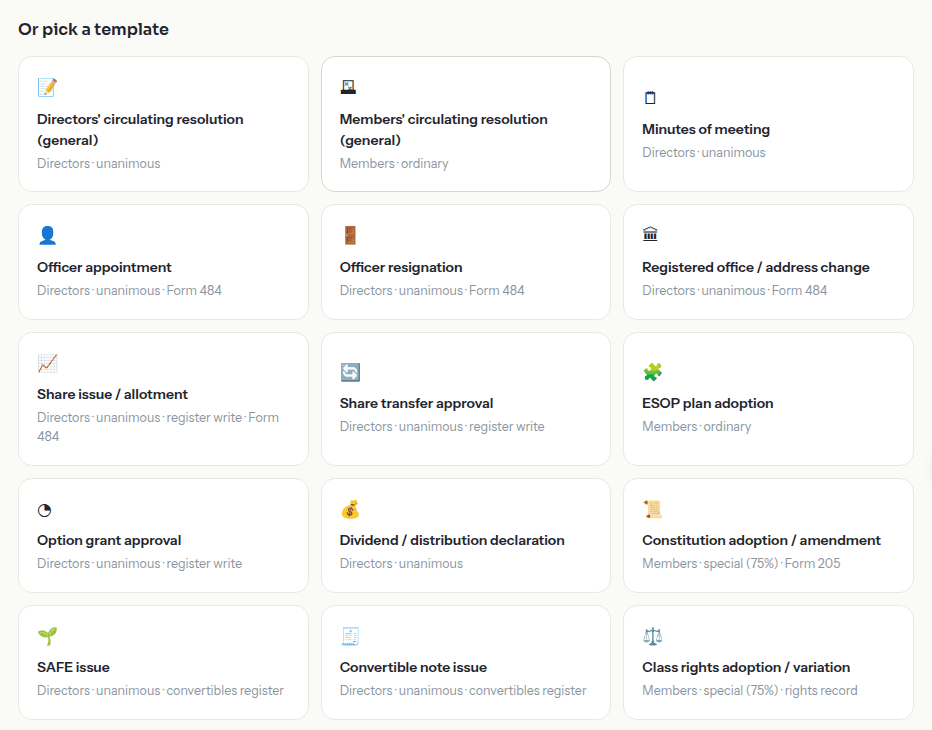
17 resolution types, or your own words
Start from the library — officer changes, share issues, ESOP grants, SAFE and convertible note issues, class-rights variations, dividends and more — each already carrying the approval threshold it needs and a flag for whether it has to go to ASIC. When nothing in the library fits, describe the change in plain language and Veela drafts a general circulating resolution from your own words instead.
- 17 resolution types, from officer changes through to class-rights variations
- Each one pre-set with its approval threshold and its ASIC lodgement flag
- A general resolution, drafted from your own description, when nothing else fits
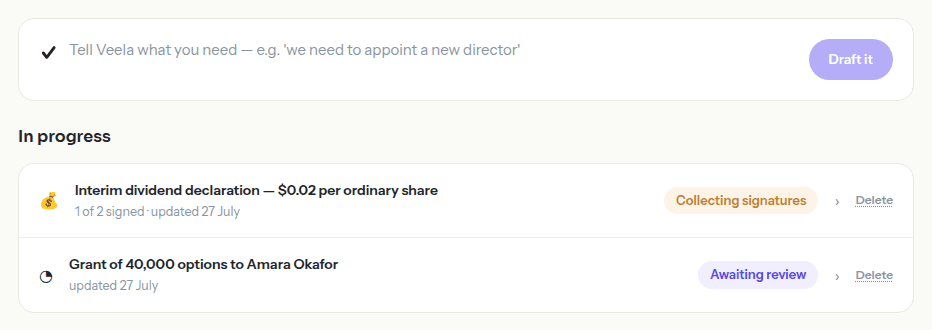
Tell Veela what you need — it does the assembly
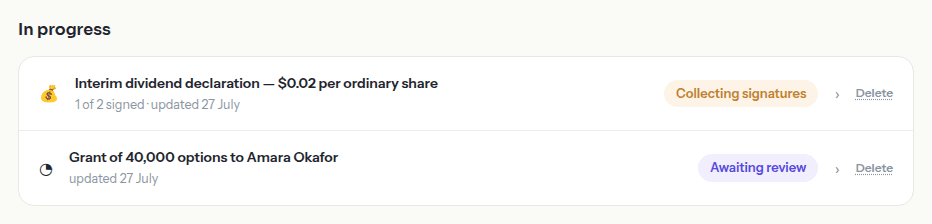
Describe the change you're making and the request joins the queue alongside whatever else is already in progress. Nothing is drafted blind: the request is read against your constitution, your plan rules and the register as it stands today, not against a static form somebody filled in six months ago. That is the part a lawyer charges an hour for and the part a template pack can't do at all.
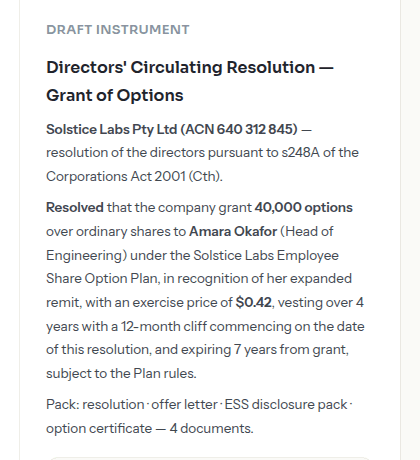
A draft with its reasoning attached
Every resolution comes back with the clause it relied on named alongside the drafted text — the constitution provision that set the threshold, the ESOP rule that set the vesting, the register entry it read the current holding from. You are never asked to approve a document whose working you can't see.
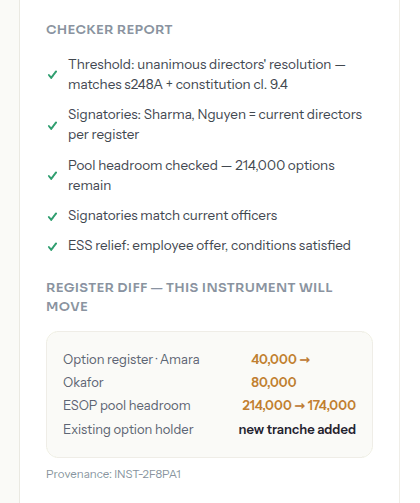
The Checker runs before anyone sees it — every time
An independent checker validates every draft before it reaches a human, against checks that can't be skipped or waived: the right people are signing, the threshold your constitution sets has actually been met, and there are enough unissued shares or unallocated options for the resolution to do what it says. The same checks run on every draft, not as a spot-check somebody thinks to ask for. It also produces the register diff the resolution would cause if it passed.
- Signatories checked against your current officers, every time
- Approval threshold checked against your constitution, not assumed
- Enough unissued shares or unallocated options confirmed before the draft is offered for review
- The register diff the draft would cause, shown before anyone signs
A checked draft is not a circulated one
Passing the Checker makes a draft ready, not sent. On Solo it stays clearly labelled unreviewed and it's yours to decide when to circulate. On Team it routes to your reviewing company secretary first, who sees the draft, the Checker's report and the register diff it would cause side by side, and either approves it for release to signature or bounces it back with comments. Either way the decision is recorded against the A1 gate — a named human's call on the record, not an AI's.
- Solo: the draft stays clearly labelled unreviewed — yours to send when you're ready
- Team: your reviewing company secretary sees the draft, the Checker report and the register diff together
- Approve and release for signature, or bounce with comments — either decision is recorded
- Nothing crosses this gate on an AI output alone
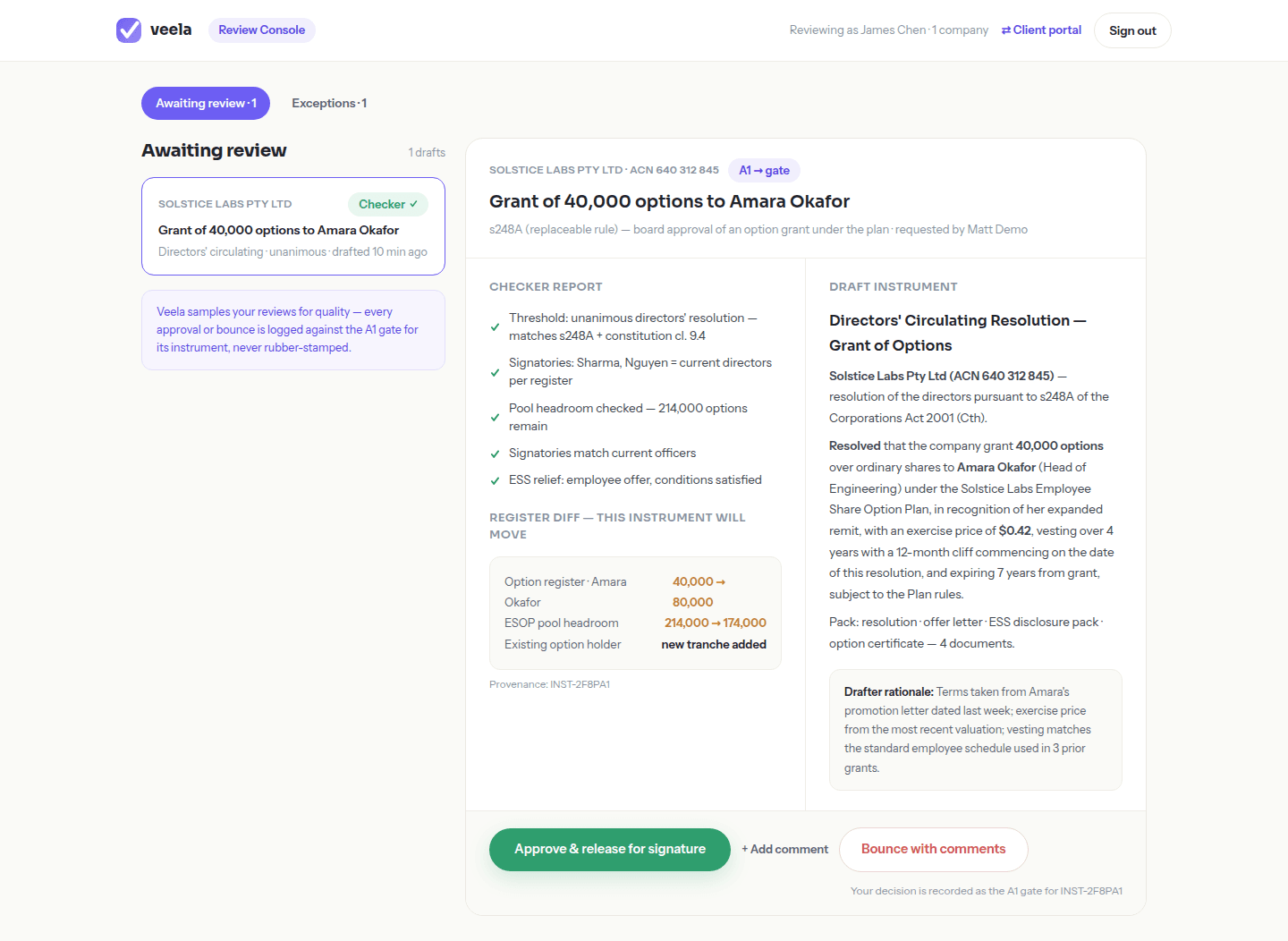
Sign without accounts
Circulate a resolution and every signatory gets their own personal link by email — open it on a phone or a laptop, read the resolution, sign. There's no account to create, no password to remember and nothing for a director to install first. The link is personal to the person it's addressed to, so it's always clear whose signature is still expected and nobody can act in their place. E-signature is included by default; nobody needs a DocuSign account to sign your resolutions.
- Personal signing links by email — opens and signs from any device
- No account needed for any signatory, on any plan
- The link stays personal — Veela reminds you not to forward it
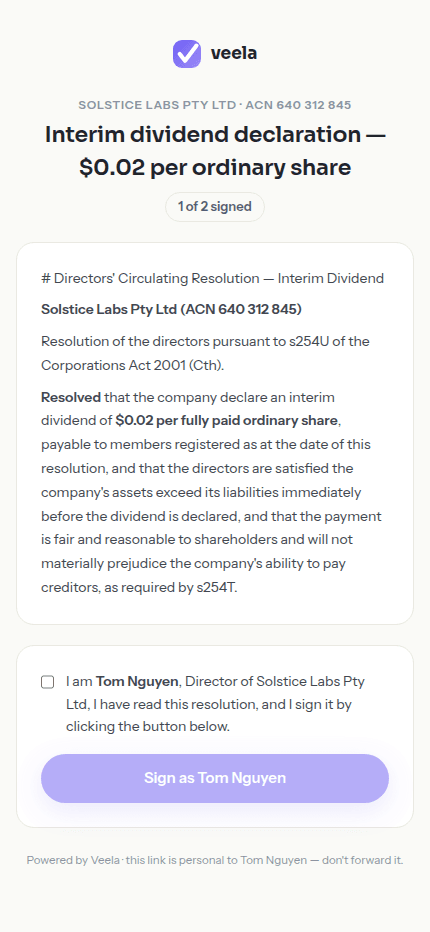
Watch who's signed and who's still outstanding
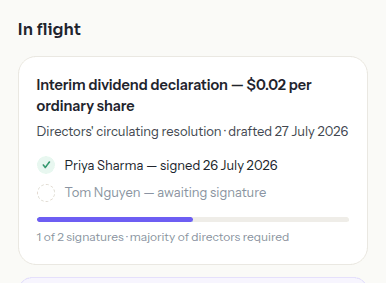
A live progress bar tracks every signatory as they sign, so you always know what's still needed before the resolution passes — majority of directors, all directors, or whatever threshold applies. Resend a link to somebody who hasn't opened theirs in one click, and ask Veela directly who's holding things up. On Team, everyone with a seat sees the same progress rather than only whoever sent it.
- A live progress bar — 1 of 2, 2 of 3, whatever the threshold requires
- Resend controls for any signatory who hasn't opened their link
- Visible to the whole team, not just the person who circulated it
Wet ink, or your own provider — both work
Not every signatory wants to sign on screen. Print, sign and upload works just as well: Veela records each wet-ink signature individually against the resolution, with the same evidence trail as a link. And if your board already runs DocuSign, PandaDoc or Annature, connect it and circulate through that instead — Veela still tracks status and files the result in the same minute book. Mix and match freely; one director can sign on screen while another prints and uploads, on the same resolution.
- Print, sign, upload — each signature recorded individually
- Bring your own DocuSign, PandaDoc or Annature if you'd rather
- Disconnect at any time and fall back to Veela's included links
Ask before you draft — and the AI proposes rather than acts
Not sure whether a template fits, or whether your constitution even allows what you're planning? Ask first. A contextual dock rides along on every portal page and already knows what you're looking at, so you don't re-explain the screen. Every answer comes back with citation chips pointing at the document or register entry it drew on. When the answer is really an action — draft this, mark this task done — it proposes it and you click to confirm. It cannot sign, cannot lodge and cannot write to a register: a human click does those, every time.
- Answers cite the clause or register entry they came from, so you can check the working
- Actions are proposed and click-confirmed — nothing consequential happens on a chat reply
- It cannot sign, lodge or write to a register — those are human clicks, every time
- Ask Veela reads the library through the permissions of whoever is asking — an admin-only document never reaches the model for anyone who can't open it
214,000 options remain unallocated in the 1,200,000 pool.
AI proposes · you confirm
Illustrative — Solstice Labs demo data
What the AI costs, and the cap that stops it
Drafting a resolution here costs a few cents of model usage rather than an hour of somebody's time, and it's metered where you can see it rather than buried in the subscription. Every plan includes $10 of usage a month — roughly 90 questions or two dozen drafted resolutions — and beyond that it's pay-as-you-go. Every company also sets a hard cap. When the cap is reached Veela stops answering; it does not keep going and send you the bill.
- $10 of Ask Veela usage included every month, on every plan
- Then pay-as-you-go, metered per company and visible on your billing page
- A hard monthly cap you set — reaching it stops Veela answering, rather than running up a bill
- Included in the subscription from $10 a month, not charged per seat
Why this matters if you’re a Pty Ltd
A Pty Ltd constitution sets its own rules for who approves what, and getting that wrong on paper causes real problems later — an ASIC lodgement that doesn't match the minute book, or a resolution a court won't accept as validly passed. Drafting from your actual facts, checked every time, is how the paperwork behind a decision ends up as sound as the decision itself.
Your constitution sets the rules, not a generic form
Every Pty Ltd constitution sets its own thresholds for who must approve what. Veela drafts and checks against the clause actually on file for your company, not a one-size-fits-all template.
The decision and the register move together
A drafted share issue and the register update are the same document, not two — which is why the members register you must keep can't drift away from the minute book behind it.
AI proposes, a named human confirms
On Team, every draft stops at a reviewing company secretary before it circulates. A person decides, every time, and that decision is recorded against the gate it cleared.
ASIC's 28-day window, flagged upfront
An officer change or a new share issue starts ASIC's 28-day notification window the moment it passes. Any draft that triggers it is flagged while you're still drafting, ready for the ASIC hub.
Signature evidence that stands up
Every signature — on screen or wet ink — is recorded against the resolution individually with a timestamp, so the evidence survives a due-diligence request or an ASIC query.
No account, no excuse to delay
A director who'd otherwise sit on a printed pack can sign from a phone in minutes — which matters when someone is travelling and the resolution is genuinely time-sensitive.
Not sure? Just ask Veela
Ask Veela before you draft anything at all. It reads your constitution, your plan rules and your live register to tell you what actually applies to your company — then, if you want it to, takes you straight into the right draft. It proposes; you decide.
- “Can we grant options without a shareholder vote?”
- “What threshold applies to removing a director?”
- “Who hasn't signed the dividend resolution yet?”
- “Can Priya sign this one by print and upload instead?”
- “Does issuing these shares need an ASIC lodgement?”
Keep exploring
A sentinel that opens the work early — the annual review, director ID, ESS reporting, option expiries — and ASIC packs that build themselves.
Read more →Registers, class rights and the minute book, written by the resolutions that passed — with the as-at-date export and the citations a data room asks for.
Read more →See it running on your own facts
Start free for 7 days, or try the no-signup sandbox first — same platform, illustrative data.